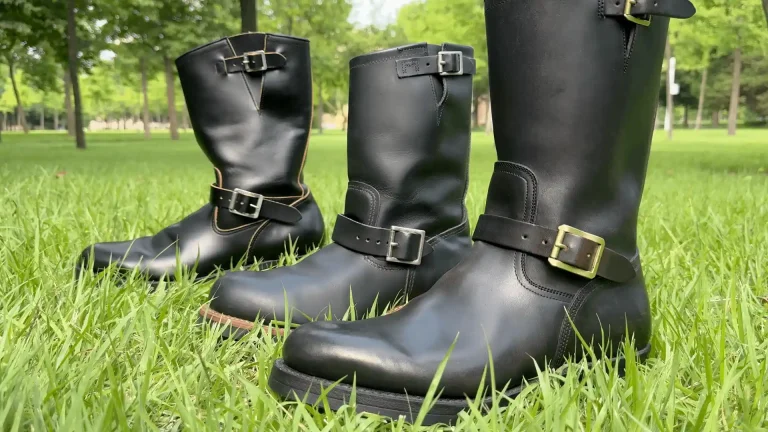
Engineer boots can be made from very different types of leather, and they do not all respond to care products in the same way. A conditioner that works well on steerhide may be unnecessary on waxed kipskin, while products made for smooth leather can permanently change the surface of nubuck.
That is why it helps to understand the leather itself before deciding how to care for it.
This guide covers four leathers I have worn and cared for myself: steerhide, waxed kipskin, horsebutt, and nubuck. Each one has different characteristics, different weak points, and a slightly different approach to care.
The goal is not to create a complicated routine for each leather. In many cases, the safest approach is actually simpler. The important part is knowing what the leather needs before reaching for a cleaner, conditioner, wax, or waterproofing product.
Table of Contents
Leather Care Rules That Apply to Most Engineer Boots
My routine with most engineer boots is pretty simple. I brush them regularly, especially if they’ve picked up dust or dirt, and most of the time that’s all I do.
I don’t condition them just because a few months have passed. Sometimes I’ll go six months or longer without using anything. If the leather still looks good and doesn’t feel dry, I usually leave it alone. I’ve found that adding more product doesn’t necessarily make a boot better, and with some leathers it can actually create more problems.
If a pair gets wet, I just give it time to dry at room temperature. I also use shoe trees, although I’m careful with the size. I once used a tree that was too large and ended up putting more pressure on the leather than I wanted.
That’s basically where I start. Once you get into different leathers, though, the differences become much more important.
How I Care for Steerhide Engineer Boots
Steerhide is probably the easiest leather of the four to live with. It’s tough, fairly forgiving, and doesn’t need much attention day to day. That’s one reason it has been used so often for work boots.
Most of the time, I just brush my steerhide boots and keep wearing them. When the leather starts looking a little dry, I’ll use a small amount of conditioner, work it in evenly, and then leave the boots alone for a while. I don’t try to keep the leather looking freshly conditioned all the time.
One thing I learned with steerhide actually had nothing to do with conditioner. I once put an oversized shoe tree into a pair of engineer boots and left it there. The pressure gradually stretched the leather around the vamp and changed the fit more than I expected. Steerhide is strong, but it can still stretch when you keep it under tension long enough.
So these days I’m more careful about shoe tree size, and otherwise I don’t do much unless the leather gives me a reason to. For steerhide, regular brushing and occasional conditioning have been enough for me.
How I Care for Waxed Kipskin Engineer Boots
My waxed kipskin boots get very little product. They came with a black wax finish, and for regular wear I mostly brush them and wipe off dirt with a damp cloth. I rarely condition them. The factory wax finish already provides some protection, and over time I’ve found there isn’t much reason to interfere with it.
I did learn that the hard way. I once used a strong cleaner on a mark near the toe and ended up taking off some of the black wax with it. The brown underneath became visible almost immediately. I later tried to restore the black, but the finish in that area was never quite the same. The difference is still visible when the boots are side by side.
That experience made me much more cautious about cleaning waxed kipskin. A product can work perfectly well for another leather and still be too aggressive here. In my case, there was no real reason to use something that strong in the first place. I was trying to remove a small mark and ended up creating a much more permanent one.
These days I don’t do much beyond brushing and occasional cleaning with a lightly damp cloth. If something doesn’t come off easily, I would rather leave it for the moment than immediately move to a stronger cleaner. The boots are going to pick up marks as they age anyway, and I’ve become much less interested in trying to correct every one of them.
How I Care for Horsebutt Engineer Boots
Horsebutt was a different experience for me. My pair was noticeably stiffer when new, especially compared with steerhide or kipskin. During the first few wears, I even wondered if I had bought the wrong size.
After a few weeks, though, the leather started to relax. The boots gradually became easier to wear, and after a few months the difference was much more obvious. Most of that change came simply from wearing them.
That’s why I don’t use conditioner to try to speed up the break-in. It will soften the leather, but I would rather give horsebutt time to break in through regular wear. Part of what I like about this leather is how it develops its shape and character slowly.
I also use conditioner pretty sparingly. Horsebutt doesn’t seem to take it in as quickly as steerhide, and using too much can leave product sitting on the surface longer than I want. That’s something I’m especially careful about in humid weather, when the boots may already take longer to dry.
With my pair, I’ve had better results doing less and giving the leather more time. Horsebutt rewards patience, and the best changes usually come with wear.
How I Care for Nubuck Engineer Boots
Nubuck is the one I treat most differently. The grain side is lightly sanded to create that soft, velvety surface, so products I would normally use on smooth leather can change the way nubuck looks.
I don’t use regular leather cream, wax, or oil on my nubuck boots. They can darken the leather and flatten the nap, and once that happens, it can be difficult to get the original look back.
My sand nubuck engineer boots made this pretty obvious during the first few weeks. Every little scuff, dark spot, and bit of denim transfer showed up against the light color. At first, I wanted to clean those marks whenever I saw them. I ended up leaving most of them alone, and with more wear they gradually started to blend together. What looked like random marks early on became part of the way the boots were aging.
For regular care, I use a suede brush to bring the nap back up and a rubber eraser when there’s a scuff that actually bothers me. If I need extra water resistance, I use a spray made specifically for nubuck or suede.
I’ve found that nubuck gets easier to live with once you stop expecting it to stay perfectly clean. With more wear, the individual marks don’t stand out nearly as much.
How to Know What Your Leather Actually Needs
After living with these four leathers, I’ve become much less interested in following a fixed care schedule. I pay more attention to the leather itself.
Before I use anything, I look at what kind of leather it is, how the surface is finished, and what has actually changed with wear. Quite often, brushing is enough. I only add conditioner when the leather seems to need it, and I’ve also learned that leaving a pair alone can be better than trying to fix every change I see.
That’s probably the biggest thing I’ve learned from caring for my engineer boots. A good care product can still be the wrong product for a particular leather. Knowing what you’re working with matters more than following the same routine every time.
I wish I’d understood that earlier. It would have saved me from a few mistakes, including that missing patch of black wax on my kipskin boots.
The Complete Engineer Boots Guide: Fit, Break-In, Teacore & Styling
How Attractions Engineer Boots Develop Patina After 90 Days (Sand Nubuck)