
Rimowa’s pretty much the rockstar of luggage. You can spot that sleek, grooved aluminum shell a mile away in any airport, and it’s got this rep for being tough as hell, holding up through years of getting tossed around. Sure, they cost a fortune, but for a lot of travelers, it’s a buy-it-for-life kinda deal. Every scratch and dent just adds to the vibe, like a passport stamp telling the world where you’ve been.So, you’re set on a Rimowa Original, but now you’re sweating over the size: Check-In M or Check-In L? Sounds like a no-brainer—one’s bigger, right? But it’s not that simple. The size you pick changes how easy it is to drag around, whether it’ll pass airline rules, how much you can cram in, and even how beat-up it looks over time. I’ve lugged both through airports, trains, and sketchy sidewalks, and I’ve nerded out over the details. Here’s the full scoop to help you figure out which one matches your travel style.
Let’s set the stage before we get into the whole Check-In M vs. L showdown. The Rimowa Original series is basically the cool kid of suitcases, the modern take on their iconic Topas line. They didn’t reinvent the wheel when they rebranded it as the Original—it’s the same badass vibe with some slick upgrades.Here’s what you’re getting with either size:
- That classic grooved aluminum shell—tough as nails, instantly recognizable, and yeah, it’ll pick up scratches and dings (but that’s half the charm, like a well-traveled leather jacket).
- Buttery-smooth multiwheel system—glides like a dream over airport floors, sidewalks, or even those annoying cobblestone streets.
- TSA-approved locks—built right in, no fuss, and they keep your stuff safe.
- Flex Divider system—fancy interior panels you can adjust to keep your clothes from turning into a crumpled mess.
- Telescopic handle—slides up and down smoothly, locks in place, and doesn’t wobble.
Whether you go for the M or L, you’re getting the same top-notch quality, materials, and design. It all boils down to size, weight, and how you’re gonna roll with it on your trips.
Table of Contents
Specs: Rimowa Original Check-In M vs Check-In L
Here’s the side-by-side breakdown of the two sizes:
| Feature | Check-In M | Check-In L |
|---|---|---|
| Dimensions | 26.4 × 17.8 × 9.5 in (68 × 45 × 24 cm) | 31.2 × 20.1 × 10.7 in (79 × 51 × 27 cm) |
| Capacity | 60 liters | 86 liters |
| Weight | 5.4 kg (11.9 lbs) | 6.2 kg (13.7 lbs) |
| Typical Trip Length | 4–6 days | 8–12 days |
Key observations:
- The L is about 43% larger in capacity — that’s a big jump.
- The weight difference is minimal: less than 1 kg separates them.
- The dimensions are where you feel it: the L is taller, wider, and deeper. That extra bulk can make it more awkward in some travel scenarios.
Real-World Travel Scenarios
Picking between the Check-In M and L isn’t just about numbers—it’s about how you actually travel. Let’s break it down with some real-world scenarios so you can picture which one’s your vibe.
Short Trips: 3–7 Days
The Check-In M is your go-to here. Its 60L capacity is plenty for a week’s worth of clothes, a pair of shoes, maybe a jacket, without feeling like you’re lugging a monster. It’s light, easy to whip through busy train stations or tiny hotel lobbies, and it slides right under most airlines’ checked baggage size limits. If you’re bouncing around a lot—switching hotels every couple of nights, riding trains across Europe, or mixing a bit of work with play—the M hits that sweet spot of enough space but not a pain to deal with.
If you’d like to see the Rimowa Original Check-In M in action, I filmed a detailed review after real-world use. This video shows its capacity, portability, and why it works so well for shorter trips:
Longer Vacations: 10–14 Days
This is where the Check-In L steps up. With 86L, you’ve got room to breathe—think multiple outfits, heavier layers, or that extra pair of boots you swear you won’t pack but always do. If you’re chilling in one spot for a while—like a resort, an Airbnb, or crashing with family—the L’s perfect. You’re not unpacking and repacking every other day, so the bigger size doesn’t feel like a hassle.
For a closer look at the Rimowa Original Check-In L, here’s my video review based on extended travel. I go over how much it actually holds, how it handles at airports, and what kind of trips it’s best suited for:
Long-Term Travel: 3+ Weeks or International Moves
The L can handle this, but here’s the catch: it’s super easy to overpack that 86L and go past the 23kg (50 lbs) airline weight limit, which means coughing up extra fees at the counter. Unless you’re a packing ninja, that bigger size can screw you over. A better move? Pair the M with a carry-on cabin case. You get flexibility, keep the weight in check, and avoid wrestling with one giant suitcase that’s a nightmare to lift or store. It’s like splitting the difference without losing space.
Portability and Handling
Think about how you handle the suitcase, not only the size.
Check-In M: It is easy to move in small spaces, like metro stations, narrow hotel halls, or small cars. It is also easy to lift into a car trunk or onto a luggage rack. If you travel alone, this is more important than you think.
Check-In L: It is more big and heavy. On trains, you may have trouble putting it in the overhead rack or the luggage space. It can also feel hard to roll on narrow sidewalks or cobblestones. But when it moves, the wheels make it roll smooth.
Cost Considerations
Price is usually not the deciding factor between these two. The M runs about $1,700, while the L is roughly $1,800 — a small difference given the overall cost.
Instead, think about value per trip:
- If you mostly take short trips, the L is wasted space.
- If you’re often away for two weeks at a time, the M will frustrate you with its limits.
Both sizes hold value extremely well on the second-hand market. Rimowa aluminum cases are sought-after on resale sites, so if you ever change your mind, you’ll get a decent return.
Durability and Wear
Both suitcases are equally tough — they’re built from anodized aluminum and will show scratches and dents almost immediately. This is part of Rimowa’s character.
- M: With less surface area, scratches and dings feel more controlled. It weathers travel gracefully and develops a subtle patina.
- L: The larger surface makes marks more obvious. If you’re checking it often, expect it to look well-traveled faster.
Neither will “stay new,” and that’s not the point. A well-worn Rimowa looks better than a pristine one.
Which One Should You Buy?
Here’s the bottom line:
- Choose the M if…
- You travel solo or with light packers.
- Your trips are usually under 7 days.
- You prefer something easier to maneuver and lift.
- You already have a cabin case and don’t need a giant suitcase.
- Choose the L if…
- You take trips longer than 10 days.
- You pack multiple outfits, shoes, or bulky clothes.
- You want one suitcase that can handle almost anything.
- You don’t mind the extra bulk when moving around.
Buyer Personas
- Business traveler: Go with the M — it’s enough for suits, shirts, and essentials without overkill.
- Family vacationer: The L makes more sense, especially if you’re packing for kids.
- Minimalist traveler: The M forces you to stay disciplined.
- Occasional big-trip traveler: The L is safer if you only want to own one suitcase.
Conclusion
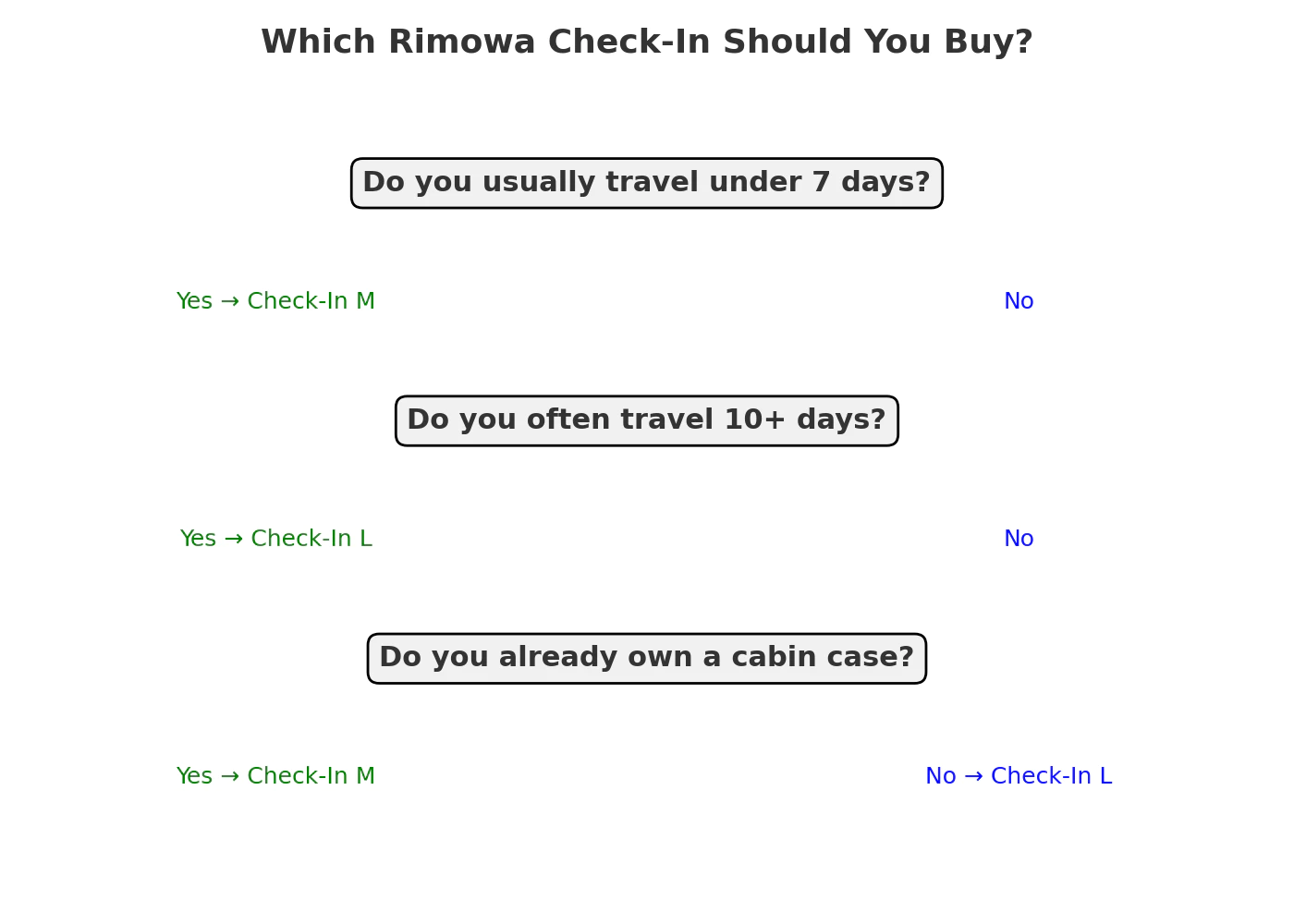
The choice between the Rimowa Original Check-In M and L is not about which is better. It is about which is better for you.
The M is light and easy and good for a week away. The L is big and flexible and good for long trips. Both have the same build, the same design, and the same way of aging well over years of travel.
Ask yourself: do you pack for short and often trips, or long and rare ones? That is the real choice.
No matter which you pick, you get a suitcase that is useful and classic. It will carry your things and also the marks and stories of your travel.
So, which one do you pick, the M or the L? Share in the comments.
Discovering the Rimowa Original Compact: A Detailed Luxury Suitcase Review


